
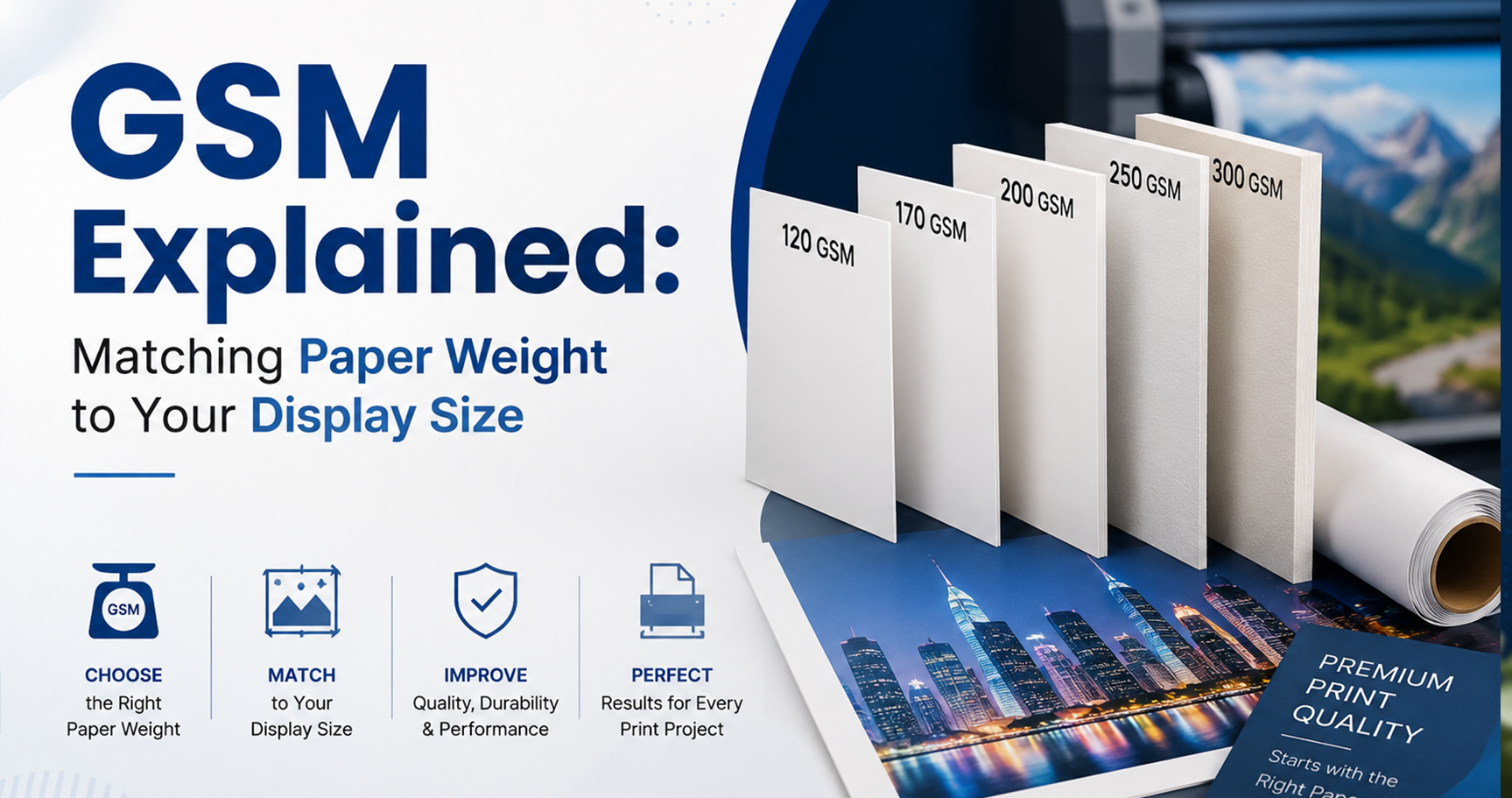
When it comes to large-format printing, choosing the right paper is about more than just colour and print quality. Paper weight, measured in GSM (grams per square metre), plays an important role in how a printed material looks, feels, handles, and performs after installation.
Whether you are producing posters, signage, displays, promotional graphics, presentations, or other large-format applications, selecting the appropriate GSM can make a noticeable difference in the final result.
A heavier paper does not always mean better quality. The right choice depends on the display size, application, handling requirements, printing method, and intended lifespan of the finished print.
What Does GSM Mean?
GSM stands for Grams per Square Metre. It indicates the weight of a sheet of paper based on an area of one square metre.
For example, a paper rated at 200 GSM weighs approximately 200 grams per square metre.
GSM is commonly used to compare paper weights, but it does not directly indicate the thickness, stiffness, or quality of the paper. Two papers with the same GSM can have different thicknesses and textures depending on how they are manufactured.
Understanding GSM helps printers and customers choose a suitable material for a particular application.
Why Is GSM Important in Large-Format Printing?
Large-format prints are often much bigger than standard documents. As the size increases, the paper needs to maintain its shape and handle the demands of production, transportation, installation, and display.
Choosing an unsuitable paper weight can lead to issues such as:
- Excessive curling
- Poor handling
- Wrinkling
- Reduced rigidity
- Easier tearing
- Difficult installation
- Unwanted transparency
- Shorter practical lifespan
The right GSM helps create a print that is easier to handle and better suited to its intended purpose.
Common GSM Ranges for Printing
Different applications require different paper weights. While exact requirements vary depending on the material and printing system, GSM can generally be considered in several broad ranges.
Lightweight Paper
Lightweight papers are easier to handle and can be suitable for temporary promotional materials, flyers, posters, and applications where flexibility is important.
They are generally more economical and easier to transport, but may not provide the rigidity required for larger displays.
Medium-Weight Paper
Medium-weight papers offer a balance between flexibility, durability, print quality, and handling.
They can be suitable for posters, indoor promotional graphics, presentations, and general display applications where a more substantial feel is required.
Heavyweight Paper
Heavier papers provide increased rigidity and a more premium feel.
They are often considered for high-quality posters, professional displays, presentation graphics, and applications where the printed material needs to maintain its shape during handling and display.
Matching GSM to Display Size
The physical size of the print is an important consideration when selecting paper weight.
A small poster may perform perfectly well on a medium-weight stock, while a much larger display may require a stronger or more rigid material.
Small-Format Displays
For smaller posters and promotional prints, lightweight or medium-weight paper can often provide sufficient strength.
These applications generally do not require extreme rigidity because the print is easier to support and handle.
Medium-Format Displays
As the print size increases, medium-weight paper can provide a useful balance between flexibility and stability.
This range is suitable for many indoor posters, promotional displays, presentations, and decorative graphics.
Large-Format Displays
Large prints require greater attention to handling and installation.
Heavier paper or specialised large-format media can help reduce excessive movement, curling, and handling difficulties.
However, simply choosing the heaviest available paper is not always the best solution. The installation method and display environment should also be considered.
GSM and Opacity
Another important factor affected by paper selection is opacity.
Opacity determines how much light passes through the material. Lightweight papers may allow more light to pass through, which can become noticeable when the print is displayed near windows, lighting, or other bright sources.
A higher-weight or specially engineered material may provide better opacity and a more solid appearance.
For professional displays, selecting a paper with suitable opacity can help maintain consistent colours and improve the overall visual impact.
GSM and Curling
Curling can be a common concern in large-format printing.
Paper reacts to environmental conditions such as temperature and humidity. The printing process itself can also affect how the material behaves.
A paper that is too light for a particular application may be more difficult to handle and may show noticeable curling after printing.
Choosing an appropriate media weight and using proper storage and finishing practices can help minimise these issues.
Does Higher GSM Mean Better Quality?
Not necessarily.
A common misconception is that a higher GSM automatically means higher quality. In reality, GSM is only one factor in determining the performance of a printing material.
Other factors include:
- Paper composition
- Coating
- Surface finish
- Opacity
- Brightness
- Texture
- Ink compatibility
- Durability
- Printing technology
- Intended application
A lightweight premium paper can sometimes perform better for a particular application than a heavier paper that is not designed for that purpose.
The goal is to choose the right material, not simply the heaviest one.
Glossy, Matte, and Other Finishes
GSM should also be considered together with the surface finish.
Glossy Finish
Glossy surfaces can provide strong colour vibrancy, contrast, and visual impact. They are often suitable for photographic posters, promotional graphics, and applications where vivid colours are important.
Matte Finish
Matte surfaces reduce reflections and provide a softer, professional appearance.
They can be useful for posters, information displays, presentations, and environments with strong lighting.
Satin or Lustre Finish
Satin and lustre finishes provide a balance between colour vibrancy and reduced glare.
They can be particularly useful for photographic and professional display applications.
The ideal combination depends on both the paper weight and the visual effect you want to achieve.
Choosing GSM for Different Applications
Different large-format applications have different requirements.
Posters
Posters intended for short-term indoor use can often use medium-weight paper, while premium or long-term posters may benefit from heavier stock or specialised media.
Retail Displays
Retail graphics need to look attractive while remaining easy to install and maintain. The appropriate GSM depends on the display size and whether the graphic is mounted, framed, or suspended.
Exhibition Graphics
Exhibition displays often require materials that are easy to transport while maintaining a professional appearance.
A balanced medium-to-heavy material can provide the necessary combination of durability and presentation.
Photography Prints
Photographic displays benefit from media that reproduces colour, detail, and skin tones accurately.
In these applications, surface finish and image quality can be just as important as GSM.
Indoor Signage
Indoor signage should be selected according to its expected lifespan, installation method, and viewing distance.
For temporary signage, a lighter option may be sufficient, while permanent displays may require a more robust material.
Consider Handling and Installation
Before selecting paper weight, think about how the printed material will be installed.
Will it be:
- Mounted onto a rigid board?
- Framed?
- Hung from the ceiling?
- Attached directly to a wall?
- Rolled for transportation?
- Frequently moved between locations?
If the material will be mounted onto a rigid surface, extreme paper weight may not be necessary.
On the other hand, a free-hanging or frequently handled display may require a material with better structural stability.
Storage and Transportation
Large-format prints can be difficult to transport, especially when produced on heavier media.
Heavier materials may provide greater rigidity, but they can also increase transportation weight and storage requirements.
For businesses producing large quantities of promotional material, finding the right balance between durability and practicality can help reduce unnecessary costs.
Properly rolled, packaged, and stored prints can also help prevent damage before installation.
How Printing Professionals Choose the Right GSM
A professional printer should consider more than just the customer’s preferred paper weight.
Important factors include:
- Final display size
- Indoor or outdoor application
- Expected display duration
- Printing technology
- Required colour quality
- Surface finish
- Installation method
- Handling requirements
- Transportation and storage
- Budget
Taking these factors into account helps ensure the selected material is appropriate for the entire project.
A Simple GSM Selection Guide
When deciding on paper weight, start by asking a few basic questions.
Is the print temporary?
If the display is intended for short-term promotional use, a lighter and more economical material may be suitable.
Is the print intended for premium presentation?
Consider a medium or heavier stock with an appropriate surface finish.
Will the print be frequently handled?
A more durable material may be preferable to a lightweight option.
Will it be displayed under strong lighting?
Consider opacity and surface finish in addition to GSM.
Is it a very large display?
Look at the complete media specification rather than choosing GSM alone. Size, installation method, and substrate compatibility are equally important.
Common Mistakes When Choosing Paper Weight
Choosing the Heaviest Paper
More GSM does not automatically mean better results. Excessive weight can increase cost and make transportation and installation more difficult.
Ignoring Display Size
A material that works well for a small poster may not perform the same way when scaled to a much larger format.
Focusing Only on Price
The cheapest material may not always be the most economical choice if it produces handling or durability problems.
Ignoring the Printing Method
Different printers and inks can have specific media requirements. Always make sure the selected paper is compatible with the printing process.
Forgetting the Display Environment
Lighting, humidity, temperature, and installation conditions can all influence how a print performs.
Final Thoughts
Choosing the right GSM for large-format printing is about finding the right balance between weight, strength, print quality, appearance, handling, and application requirements.
A heavier paper is not automatically better, just as a lightweight paper is not necessarily lower quality. The best choice depends on what you are printing, where it will be displayed, how long it needs to last, and how it will be handled.
For professional large-format printing, the right combination of GSM, surface finish, opacity, and printing technology can make a significant difference to the final result.
The right paper weight doesn’t just support the print — it helps the entire display perform better.